Why it matters
Human rights due diligence has moved from voluntary good practice to an expectation from lenders, investors, customers and — increasingly — regulators. The EU Corporate Sustainability Due Diligence Directive, lender requirements such as the IFC Performance Standards, and investor scrutiny all ask the same question: can you show that you have identified your human rights risks and are managing them?
For mining operations, the hardest of those risks usually sit at the interface between security, communities and the state. That is where the Voluntary Principles on Security and Human Rights (VPSHR) apply, and where MineRight's experience is deepest.
When to engage us
- Preparing for a lenders' human rights impact assessment or project finance due diligence
- Entering a new country, region or conflict-affected area
- Meeting EU CSDDD expectations as an operator or supplier into EU value chains
- Preparing for VPSHR membership, an annual report to the Voluntary Principles Initiative, or an external VPSHR audit
- Responding to an allegation, incident or NGO report involving security and communities
- Refreshing a site-level human rights or security and human rights risk assessment
How we work
Scoping and context review
We agree the scope, map the operating context and review existing policies, incident records, grievances and prior assessments.
Stakeholder engagement
Confidential interviews and consultation with workers, security personnel, community members, local authorities and civil society — conducted with care for safety and confidentiality.
Risk and gap analysis
We assess actual and potential impacts against the UN Guiding Principles and the VPSHR, and identify gaps in policy, procedure and practice.
Reporting and action plan
Clear, audit-ready findings with prioritised, practical recommendations that your team can implement and report against.
Implementation support
Optional support to embed changes — from training and contractor requirements to public security engagement and monitoring.
What you receive
- An independent HRIA or VPSHR assessment report, structured for internal, lender or public use
- A prioritised human rights and security risk register
- A practical action plan with owners and timeframes
- Board-level summary of key risks and decisions
- Optional scenario-based VPSHR training for security and site leadership
Standards and frameworks
Relevant experience
- Former Board member of the Voluntary Principles on Security and Human Rights Initiative (2021–2023)
- Conducted VPSHR audits across Australia, Papua New Guinea, Indonesia, Côte d'Ivoire and the Americas
- Delivered the Security Assessment for a lenders' human rights impact assessment for a major oil and gas operator
- Designed and delivered VPSHR-aligned security and human rights scenario training for multinational mining companies
- Delivered Board-level security and human rights risk reporting
Shaping VPSHR implementation guidance
Beyond site-level work, Mac has helped shape the guidance companies use to implement the Voluntary Principles. He contributed to two Voluntary Principles Initiative publications:
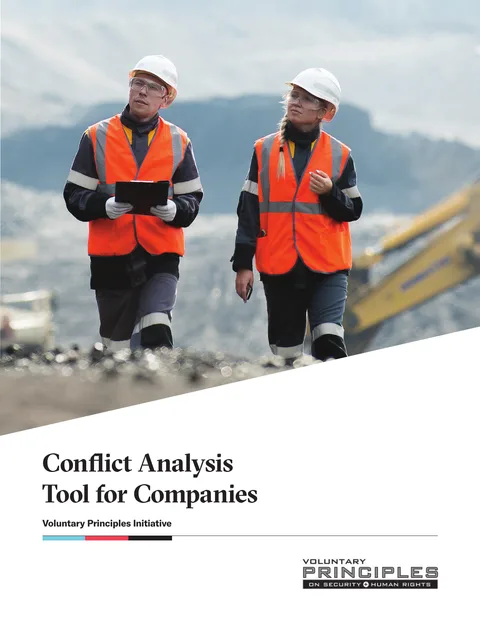
Conflict Analysis Tool for Companies
Helps company staff understand conflict dynamics around their operations, assess their own impact, and reduce human rights and conflict risks.
Developed by the VPI's multi-stakeholder Conflict Working Group. Mac is acknowledged as a contributor and reviewer.
View on voluntaryprinciples.org →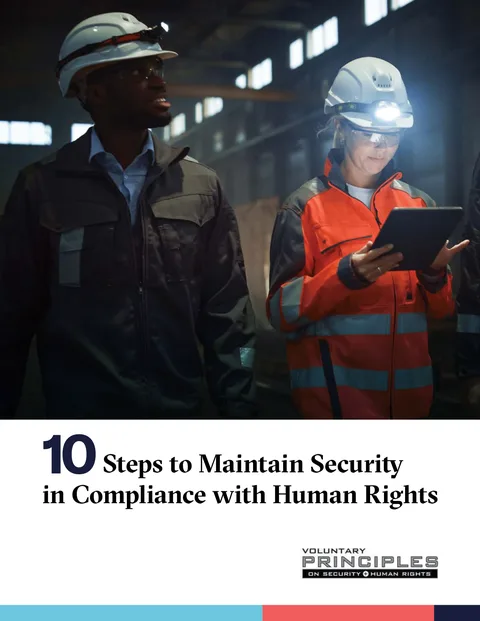
10 Steps to Maintain Security in Compliance with Human Rights
The VPI's practical starting guide (“VPs101”) for companies building a security and human rights program aligned with the Voluntary Principles.
Mac is acknowledged among the VPI members whose work made the guide possible.
View on voluntaryprinciples.org →Frequently asked questions
What is the difference between an HRIA and human rights due diligence?
Human rights due diligence is the ongoing process of identifying, preventing, mitigating and accounting for impacts. A human rights impact assessment is a structured, in-depth assessment — often of a specific project or site — that feeds that process. Most operations need both: periodic HRIAs and a due diligence system that acts on them.
Do we need to be a VPI member to apply the Voluntary Principles?
No. Many companies apply the Voluntary Principles without formal membership, and lenders and investors often expect VPSHR-aligned practice regardless. We can help you implement the Principles, assess alignment, or prepare for membership and annual reporting.
Can you assess sites in conflict-affected or high-risk areas?
Yes. Our principal has worked across Papua New Guinea, West and East Africa, Indonesia and Latin America. We plan engagement around safety, confidentiality and heightened due diligence expectations for conflict-affected contexts.
How long does an assessment take?
It depends on scope, number of sites and access. A focused VPSHR gap assessment can take a few weeks; a full HRIA with field consultation takes longer. We agree a realistic plan at the scoping stage.